
Introduction: A Surprising Dip in a Growing Journey
For more than two decades, the flow of Indian travelers to the United States has been on a steady rise. Whether for work, study, or tourism, the U.S. has remained one of the top international destinations for Indians.
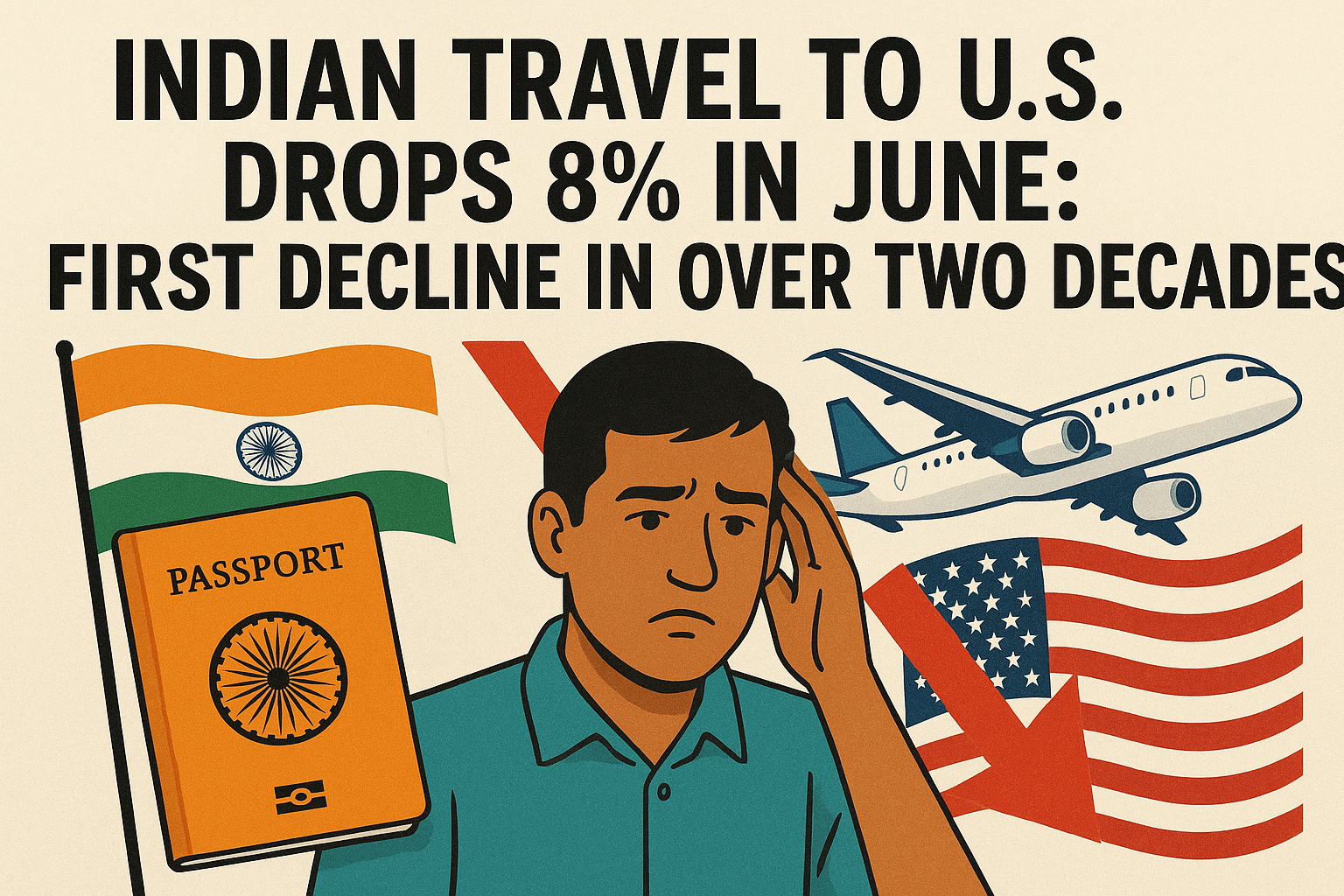
But in June, something unusual happened: Indian travel to the U.S. dropped by 8%, the first decline in over 20 years.
Why does this matter? Because Indians are one of the fastest-growing groups of international visitors to America. A sudden dip signals deeper shifts in economics, visa rules, and travel behavior.
The Numbers: What the Data Shows
According to travel and immigration officials:
- Indian arrivals to the U.S. in June 2025 fell by 8% year-on-year.
- This is the first recorded decline since the early 2000s.
- Student travel, business trips, and tourism all saw a dip.
The numbers may not seem huge at first glance, but in a trend that has been only upward for decades, even a small decline is significant.
Why Are Fewer Indians Traveling to the U.S.?
Several factors seem to be at play:
1. Visa Processing Delays
- The U.S. embassy and consulates in India have faced backlogs for visa appointments, especially for B1/B2 (business/tourist) visas.
- Some applicants are waiting months, even over a year, to get interview slots.
2. Rising Costs of Travel
- Airfares to the U.S. have soared due to higher fuel costs and fewer direct flights.
- The stronger U.S. dollar makes hotels, shopping, and dining more expensive for Indian tourists.
3. Alternative Destinations Growing in Popularity
- Countries like Dubai, Singapore, Thailand, and Europe are attracting Indian tourists with easier visa processes and cheaper packages.
- Middle Eastern hubs, especially Dubai, have positioned themselves as quick, luxurious getaways compared to long-haul U.S. travel.
4. Student Visa Uncertainty
- While Indian students still dominate U.S. enrollments, concerns about visa approvals and post-study work opportunities have made some look at Canada, the U.K., or Australia instead.
5. Geopolitical Tensions and Safety Concerns
- Political debates around immigration and safety in the U.S. may also discourage some families from sending students or traveling for leisure.
The Impact on Tourism and Business
For the U.S.
- Indian travelers are high spenders abroad, often staying longer and spending more than the average tourist.
- A decline means lost revenue for airlines, hotels, universities, and retail sectors.
For India
- With fewer travelers heading west, more money circulates locally or goes to regional destinations, strengthening India’s tourism connections with Asia and the Middle East.
Historical Context: Why This Is So Unusual
- In the early 2000s, Indian travel to the U.S. began accelerating with the rise of IT outsourcing and H-1B jobs.
- The student wave followed, with tens of thousands of Indians heading to American universities each year.
- Family visits, business conferences, and leisure trips created a steady pipeline of demand.
Even during economic downturns like 2008 or global shocks like COVID-19, demand bounced back quickly. That’s why this decline in 2025 is being seen as an early warning sign.
What Travel Experts Are Saying
Industry insiders point to both short-term disruptions and long-term changes:
- “The U.S. visa system is simply unable to keep up with demand from India.” – Travel agency owner, Mumbai
- “Young Indians are more adventurous now. Instead of saving up for one big U.S. trip, they’re taking multiple short-haul vacations.” – Tourism analyst
- “Unless the U.S. streamlines visas, it risks losing Indian travelers to Europe and Asia.” – Aviation consultant
What This Means for Indian Travelers
For Indians dreaming of visiting the U.S., the dip highlights two realities:
- Patience Will Be Key
- Visa delays aren’t going away soon. Start applications well in advance.
- Budgeting Smarter
- The strong U.S. dollar means higher costs. Travelers should plan carefully for accommodations and daily expenses.
- Considering Alternatives
- Europe, Canada, and Southeast Asia are rolling out friendlier travel policies. Travelers now have more choices than ever.
Small Analogy: The Popular Restaurant Problem
Think of the U.S. as a popular restaurant in town. For years, people lined up outside to get in, no matter how long the wait. But recently, delays got longer, prices went up, and new restaurants opened nearby. Suddenly, diners start trying other places.
The U.S. faces a similar challenge: if entry becomes too difficult or costly, travelers will look elsewhere.
Can the Trend Be Reversed?
Yes, but it requires action:
- U.S. must reduce visa backlogs through staffing and digital solutions.
- Airlines need to expand routes to bring down ticket costs.
- Tourism campaigns should target Indian audiences with better packages.
On the Indian side, agencies and travelers need to plan earlier, book smarter, and diversify destinations.
A Wake-Up Call for U.S.-India Travel Relations
The 8% drop in Indian travel to the U.S. may not be catastrophic, but it is symbolic. It shows that after 20 years of uninterrupted growth, even the strongest travel markets can hit turbulence.
For the U.S., it’s a reminder that welcoming Indian travelers requires more than just demand—it requires efficiency, affordability, and accessibility. For Indians, it’s a signal to think beyond traditional routes and explore new opportunities globally.
Check Out More U.S Content:-
https://rashtraalerttimes.com/trump-responds-to-death-rumors-never-felt-better-in-my-life/
Check Out Our More Content:-
Vegetarian Diet: A Sustainable Path to Animal Welfare in India
Vegetarian diet in India is renowned for its large vegetarian population, but meat consumption is ri…
Vantara Case Sparks Debate: Should Government Lead Wildlife Welfare Projects Across India?
Supreme Court Verdict Brings Spotlight on Vantara and Vantara Government Project The Supreme Court o…

Genetic Engineering for Wildlife: Reviving Extinct Species in India
Introduction: The Promise of De-Extinction Imagine hearing a wolf’s howl never heard for 12,000 year…

Punjab Floods 2025: Latest Impact, Causes & Urgent Lessons
Introduction In August 2025, Punjab faced its most devastating floods in nearly four decades, as ove…
Wealthy Americans Pump Record Sums Into Private Credit Funds – A New Era of Alternative Investing
Introduction: The Silent Shift in American Wealth For decades, wealthy Americans poured money into s…
India Blocks Azerbaijan’s Bid for Full Membership in the SCO: What It Means for Regional Politics
Introduction: A Diplomatic Roadblock The Shanghai Cooperation Organisation (SCO)—a powerful Eurasian…




Can you be more specific about the content of your article? After reading it, I still have some doubts. Hope you can help me.
Thank you for your sharing. I am worried that I lack creative ideas. It is your article that makes me full of hope. Thank you. But, I have a question, can you help me?
I don’t think the title of your article matches the content lol. Just kidding, mainly because I had some doubts after reading the article.
Để đảm bảo an toàn tối đa cho giao dịch, 188V áp dụng công nghệ mã hóa SSL 256-bit cùng hệ thống xác thực hai lớp (2FA) tùy chọn. Mỗi giao dịch đều được ghi nhận với mã tham chiếu duy nhất, giúp dễ dàng theo dõi và giải quyết vấn đề nếu có. TONY03-17
Thanks for sharing. I read many of your blog posts, cool, your blog is very good.
Your article helped me a lot, is there any more related content? Thanks! https://accounts.binance.com/en-NG/register-person?ref=YY80CKRN
Your article helped me a lot, is there any more related content? Thanks! https://www.binance.info/register?ref=IHJUI7TF
Thank you for your sharing. I am worried that I lack creative ideas. It is your article that makes me full of hope. Thank you. But, I have a question, can you help me?
Your article helped me a lot, is there any more related content? Thanks!
Can you be more specific about the content of your article? After reading it, I still have some doubts. Hope you can help me. https://accounts.binance.info/da-DK/register-person?ref=V3MG69RO
Thank you for your sharing. I am worried that I lack creative ideas. It is your article that makes me full of hope. Thank you. But, I have a question, can you help me?
Thank you for your sharing. I am worried that I lack creative ideas. It is your article that makes me full of hope. Thank you. But, I have a question, can you help me?
Sau khi xác nhận thành công, bạn có thể đăng nhập vào tài khoản của mình và bắt đầu trải nghiệm các trò chơi hấp dẫn tại game xn88 . Lưu ý, mỗi người chỉ được phép có một tài khoản để đảm bảo tính công bằng và tránh các rắc rối về bảo mật. TONY04-17
Thank you for your sharing. I am worried that I lack creative ideas. It is your article that makes me full of hope. Thank you. But, I have a question, can you help me?
Your point of view caught my eye and was very interesting. Thanks. I have a question for you.
Your article helped me a lot, is there any more related content? Thanks!
Your point of view caught my eye and was very interesting. Thanks. I have a question for you.
Thanks for sharing. I read many of your blog posts, cool, your blog is very good.
Thank you for your sharing. I am worried that I lack creative ideas. It is your article that makes me full of hope. Thank you. But, I have a question, can you help me?
Thank you for your sharing. I am worried that I lack creative ideas. It is your article that makes me full of hope. Thank you. But, I have a question, can you help me?
slot365 login hứa hẹn mang đến một năm 2025 bùng nổ với diện mạo mới và những nâng cấp vượt trội về hệ thống cá cược. TONY05-15
I don’t think the title of your article matches the content lol. Just kidding, mainly because I had some doubts after reading the article. https://www.binance.info/register?ref=JW3W4Y3A
Thank you for your sharing. I am worried that I lack creative ideas. It is your article that makes me full of hope. Thank you. But, I have a question, can you help me?
I hink thnis iss amoong thhe moszt importamt informaation for me.
Andd i aam glad reading your article. Buut syould
remark onn feww general things, Thee website stle iss
wonderful, tthe artiicles is realoy nice : D. Goood job,
cheers
Thanks for sharing. I read many of your blog posts, cool, your blog is very good. https://www.binance.info/register?ref=JW3W4Y3A
Goodd day! I couild have sworn I’ve ben tto this weebsite befofe bbut adter browsing through som
off the ost I realkized it’s neww tto me.Anyways, I’m definitedly
glad I ound itt and I’ll bee bookkmarking and checking back frequently!
my weeb page – roloxxx
Là một trong những nhà cái phát triển mạnh tại châu Á, XN88 slot không ngừng nâng cấp hệ thống để đảm bảo tốc độ truy cập ổn định ngay cả trong giờ cao điểm, giúp người chơi không bị gián đoạn trải nghiệm cá cược. TONY05-28
Can you be more specific about the content of your article? After reading it, I still have some doubts. Hope you can help me.